
Lately I have learned a lesson that left me with a broken heart. I discovered that in spite my good intentions, I did not know how to recycle correctly. This put in jeopardy the recycling potential of the materials my community recycles. I discovered this when I sent a question via e-mail to my recycling company. I asked them if they recycle plastic caps, aluminum paper, and envelopes with plastic windows. A couple of days later they responded “no” for these three items. They do not have the machinery to recycle plastic caps. The envelopes with plastic windows contaminates the recycled paper. Finally, the aluminum paper can be recycled because it could be “dirty”. Wao!
For years I though that all items made out of paper, plastic, and metal could be recycled. Cleanliness is the only requirement for the recycling of paper and metal. Plastic “trash” has more requirements to be recycled. That is the syndrome of “Wishful Recycling”; this happens when someone (like me) wishes and thinks that all plastic things use items can be recycled. Because all plastic with the recycling symbol can be recycled. Right?
The representative who answer my question also sent me a reference flyer. It had illustrations of recyclable and not recyclable items. I was happy to see that milk and broth cartons could be recycle. Even home appliances like televisions and washing machines can be recycled if you call the company to pick it up. On the half of “non recyclables” I saw things that surprised me: food scraps (seriously!), plastic bags (these can be recycled in grocery stores) and any container made out of Styrofoam. That was the moment I realized my own diagnosis; I am a wishful recycler. I have put so much Styrofoam in the recycling bin for years! Immediately, I go to the Internet to find information about plastics and the recycling symbol. I learned that the recycling symbol with a number inside indicates what kind of plastic resin the container is made of. It does not indicate that it can be recycled. During the 1980’s ecologist and politicians put pressure on the plastic industries due to the amount of plastic trash found in the environment. The plastic industry responded by marking containers and wrappers with the “recycling symbol” to help consumers sort plastic to be recycled. Unfortunately, not all plastic can be recycled by curbside collectors.
Then I wonder. What is done with the plastic that is not recycled and has the recycle symbol? What is done with all the other plastic things that do not have the recycle symbol in them? I am talking about straws, eating utensils, toys, tooth brushes, cables, packing material, hangers… it ends in the landfills. Here is when my frustration increases because I am still thinking that all plastic must be recycled. The irony is that plastic was originally created to substitute natural and expensive materials like ivory, silk, wood, rubber, tortoiseshell among others. Wouldn’t it be an technological advance that plastics were 100% recyclable? But, the reality is that most of it cannot be recycled and too much is used for things that are meant to be use singled use (disposable). On top of it, this synthetic material is toxic and very durable.
Due to my guilt, I looked for solutions for me and all of you who read this article. Here are a few online references:
1) plasticfilmrecycling.org: In most grocery stores there are recycling boxes for plastic bags. They can be from any store and labeled with #2 and #4 plastics. These boxes also accept Ziploc bags, produce bags and bread bags. This website also gives information on how or where to recycle plastic wraps. Like those used for paper napkins, bubble wrap, and toilet paper.
2) Earth911.org: Here you can find how to recycle almost anything. Just look in the menu what you want to recycle and your zip-code. There are many possibilities.
3) how2recycle.info: I found this website posted on a baggie of dog snacks. The instructions indicated that the baggie could not be recycled. However, when I visited the website I could tell that there are companies who want to tell their consumer how to dispose wraps and containers. The web page shows you how to read the label. It can tell you if it is recyclable, how to find a recycler, or to dispose in the trash.
4) Preserve mail in service: If you have extra cash or you live in an area with no recycling services, there is a possible solution. This company recycles #5 plastics, but you are not going to be paid for it. They use this plastic to make razors, toothbrushes, cooking utensils and other things. They have a program called Save The Caps that is dedicated for the collection of plastic caps. They work with Whole Foods. So if you live near one of these supermarkets, call them and ask if they have the collection box for caps.
5) Terracycle: With this company you have the option (once you join in for free) to look for free recycling programs. Companies like Burt’s Bees, Hasbro, Brita, Colgate, Honest can mail you an envelope for you to send back containers and wrappers to be recycled. Users can gain points and the website offers other recycling programs.
After looking for possible solutions for my problem, I decided to look for the “why”. To find it took some time and I ended up disappointed. I used to imagine that each ♲ represented a recycling machine. In my mind there was a machine with the symbol ♸ for Styrofoam cups and trays, and another machine with the symbol ♵ for nylon curtains and so on… The reality is that it cannot be like that. Each one of these plastic resins may have different dyes, chemicals and additives in them. For example, in my own house I found three different items with the symbol ♸ printed in them: a hanger, a small plastic planter, and a Styrofoam tray. The hanger is transparent and strong. The plastic planter is thin, black and very flexible. While the Styrofoam is white and sponge like and breakable. They all have the same symbol but very different from each other because their production was different. If these three items are mixed, the material left would be an unusable mess. Since my recycling company accepts plastic from #1 to #7 but no styrofoam, the hanger and the platers went to the recycling bin but the stryrofoam ended up in the trash.
Recycling plastic is expensive and the final product has less value than “virgin plastic”. It is not like that with the recycling of metal, paper, cardboard and glass. These materials generate profit. On the other hand plastic trash needs to be sorted by hand, and even though is washed, since it has been used it always has impurities in it. The most commonly recycled plastics are ♳ and ♴. These are used for liquid containers, but even these plastic are in a disadvantage. As an example, bottled water companies use virgin plastic for their bottles. If they used bottles made from recycles plastic, these bottles could have air bubbles or impurities in them. Consumers would not buy water in those bottles. Most of the recycled plastic end in Chinese factories. There they use it to make plastic lumber, sunglasses, benches, and other things that required being strong and durable. There is no such thing as a water bottle made from another water bottle, it is a lie.
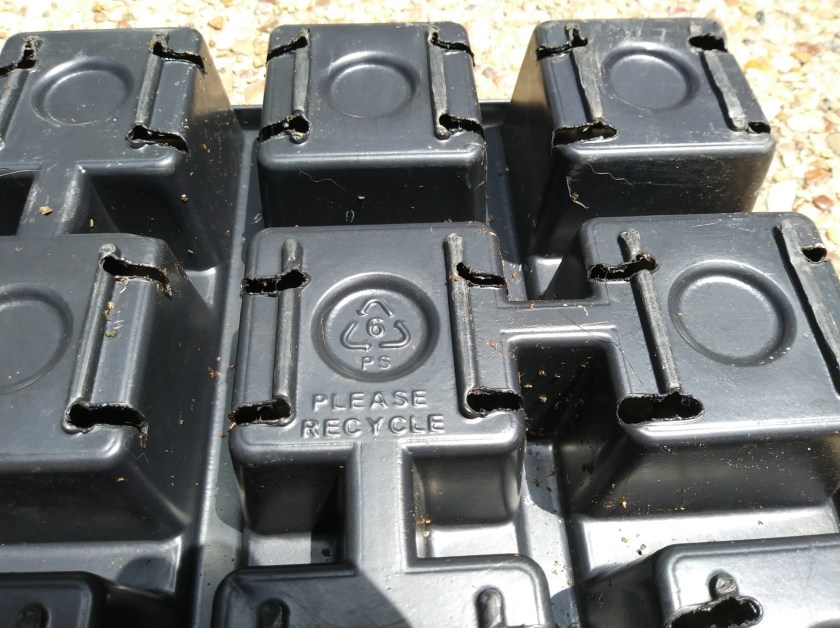
Currently neither the government of the plastic industry are motivated to recycle plastic. There is no profit in it. This is why only a small fraction of the plastic that is being made each year is recycled. We as conscious consumers can fill up those recycling bins to the top. But not all of us knows for sure which plastics are being recycled where we live. We need to learn this information and rinse if necessary. It is sad to realize that a lot of plastic will end in landfills. I hope that soon the technology to recycle all plastics is invented. Until then I will use a magnifying glass to look for these plastic resin symbols (♳, ♴, ♵, ♶, ♷, ♸, ♹) and try to do my best at recycling.
Until next time,
Gloria
 CasaNaboria